Artificial intelligence (AI) is developing at record speed and is playing an increasingly important role in everything from school and healthcare to entertainment and working life. However, in the middle of all this development, concerns are also growing. How sustainable is AI really?
In this article, I look more closely at how artificial intelligence, with a special focus on the language model “Generative Pre-trained Transformer” (GPT), can be described as sustainable. First, I explain how GPT technology works, to create a basic understanding of how these systems are built and used. After that, I assess what consequences GPT technology has for sustainability, both when it comes to climate footprint, energy use, and social and economic conditions. Finally, I discuss possible solutions that can help make the technology more sustainable, and I look at real-life examples showing how AI can be both a challenge and part of the solution.
How does an AI model work?
An AI model contains large amounts of data from books, texts, and information from the internet that it has been “fed” with. For example, if it is supposed to figure out what is a cat and what is not, it has been trained on thousands of pictures of cats and pictures that are not cats. Artificial intelligence is very good at finding patterns, such as the fact that cats often have pointed ears and are often found inside houses.
A “Generative Pre-trained Transformer” (GPT) works in a similar way. A GPT looks at what it has previously been “fed” with, and it uses patterns in language to understand what the user is asking and to generate a suitable answer.
What are neural networks?
A neural network is a little bit like the human brain. An AI computer has nodes that can be compared to brain cells. It also has weights, which are a type of mathematical connection that can be compared to the synapses in the brain. When humans learn something, we learn from experience, while an AI learns through data and training. So there are similarities, but how does it actually work?
A neural network usually works through three layers: an input layer, a hidden layer, and an output layer. These three layers are essential for the system to function. The first layer receives the data, such as pictures, text, or numbers. The hidden layer processes the data and learns patterns and characteristics. The output layer gives the answer back to us.
Each connection between the nodes has a weight, which is a number that controls how important the information is. This network of nodes adjusts the weights over time to make the model better. For example, if you give the network thousands of pictures of cats and dogs, it will learn patterns such as ears, fur, shape, and other features. When it is finished training, it may say in the output layer that an image looks like a cat. It can do this because the weights indicate, for example, that there is a 95% probability that the image shows a cat.
These weights also have another similarity with the human brain: they try to work efficiently. Every time information goes through the three layers, the model tries to find the most effective path through the nodes to reach an answer as quickly as possible.
The more nodes and weights the model has, the more calculations it must perform each time it is used. If a model has one million weights, it must perform around one million calculations, also known as operations. This produces a lot of heat because so many operations happen at once. The heat can cause servers to overheat and stop working. Because of this, water is often run through pipes connected to the servers to cool them down.
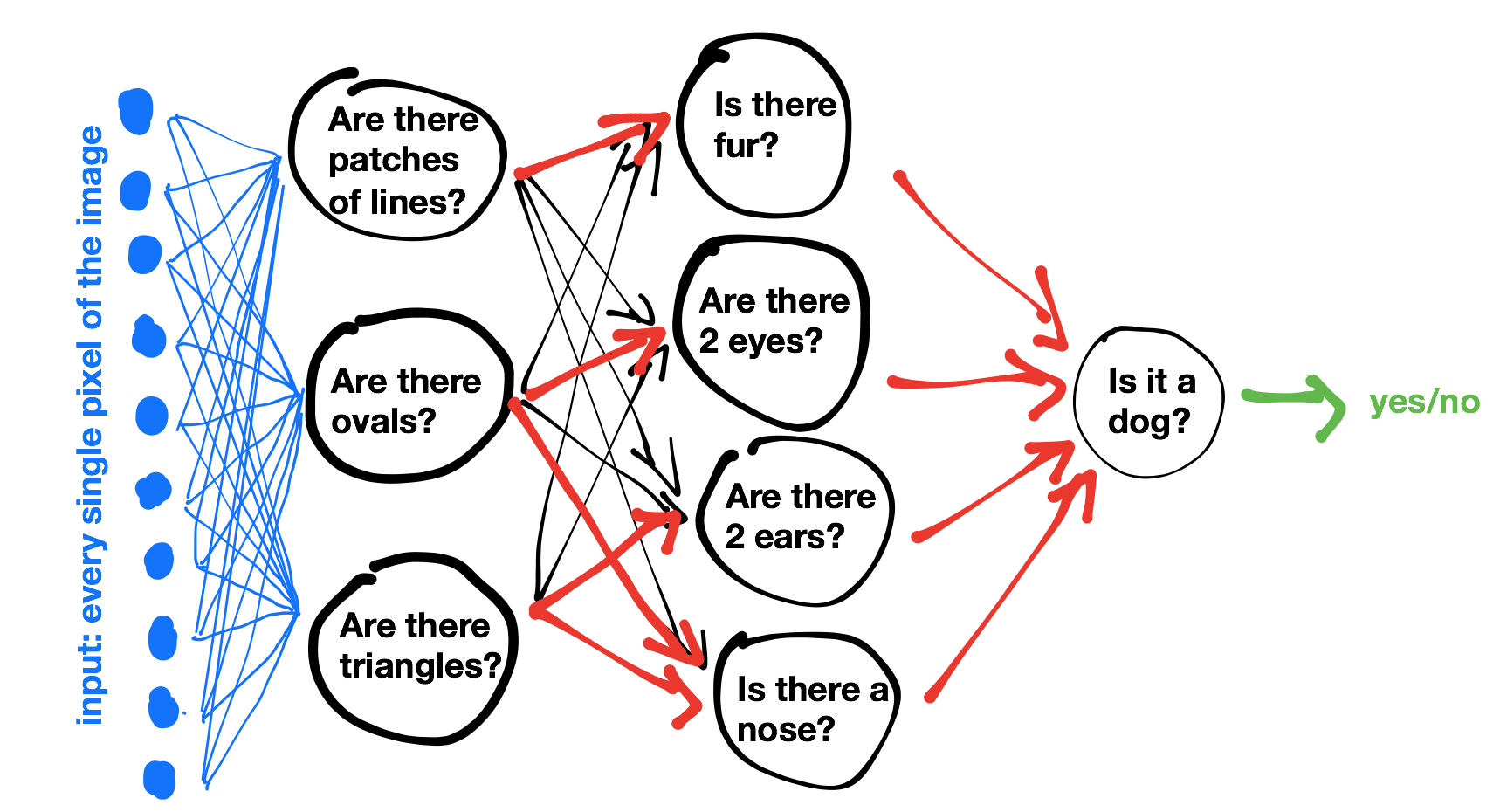
Photo from statistikk.no
ChatGPT
An example of AI, especially an LLM, which stands for large language model, is OpenAI’s chatbot ChatGPT. ChatGPT uses models in the GPT family. One example is GPT-4o. Large models can contain a very high number of weights, also called parameters, which makes them powerful but also demanding to run.
Is this sustainable?
The large servers that run AI models and give users answers require a lot of electricity and water. In some cases, an AI query can use more resources than a normal Google search. Recently, this has become a bigger and more discussed issue. But what does this mean for the economy, society, and, not least, the environment?
The three pillars of sustainability
Environmental sustainability
The positive sides
Even though AI requires a lot of electricity and water, it can also be used for useful purposes that protect the environment. For example, AI can analyse large amounts of weather data and warn about natural disasters such as floods and forest fires. AI can also be used in smart buildings to save electricity and water, for example when the building is not in use.
The negative sides
Artificial intelligence requires enormous amounts of processing power, especially when large language models are trained. This leads to high electricity consumption, which often comes from non-renewable sources and creates significant CO₂ emissions. In addition, a lot of electronic equipment used for AI becomes outdated quickly, which contributes to increasing amounts of electronic waste. This puts pressure on the environment and challenges the goal of a greener digital future. Many data centres are located in countries with cheap but not always sustainable energy. Norway also has a large energy sector, but the country has become better at using renewable energy and implementing environmental measures.
Economic sustainability
The positive sides
AI can automate and make processes more efficient. Tasks that normally would take a long time can be completed much faster. This saves time, but also a lot of money. At the same time, AI creates new jobs, such as training AI models, maintaining servers, developing new systems, and creating smart digital solutions.
The negative sides
AI can make many tasks easier for humans, but it can also cause jobs to disappear when machines take over tasks that people used to do. This may lead to higher unemployment, especially in jobs with routine-based tasks. At the same time, wealth can become concentrated among the largest technology companies, which own and develop AI technology. This can increase the gap between rich and poor. Smaller companies may struggle to compete, and some industries may be pushed out completely. AI creates economic opportunities, but not for everyone.
Social sustainability
The positive sides
AI can be used in many helpful ways in society. It is a useful tool that can support many people. AI can read text aloud, translate languages, and explain things in a simple way, such as how to restart the internet or solve a technical problem. However, it must be used responsibly.
The negative sides
AI systems can be biased and unfair if they are trained on data that already contains prejudice. This has led to discriminatory practices in areas such as hiring and the justice system. In addition, many AI tools collect personal information without people fully understanding it, which challenges the right to privacy. This can lead to mistrust of the technology and a feeling of being watched. Social sustainability is about fairness, and AI still has a long way to go in this area.
Alternatives to AI use
One alternative to using services such as ChatGPT is to download a smaller AI model, depending on how powerful your computer is, and run it locally on your own PC. This can reduce the use of water and lower electricity consumption compared to using large server systems. A normal PC has much lower energy capacity than server buildings that can be as large as family houses. One limitation is that local models often have fewer features and may not be able to generate images, but this may improve within the next one or two years.
So… is AI sustainable?
It depends entirely on how we use it. AI can be both a climate problem and a problem solver. If we use the technology wisely, for example to save energy, improve healthcare, or analyse climate data, it can contribute to sustainability. But if we allow it to grow uncontrollably without thinking about the environment, the economy, and fairness, the consequences can become serious. AI is not sustainable by itself. It is up to us to make it part of the solution instead of part of the problem.
© 2025 William Berge Grønsberg | Sources | Made for natural science